


Introduction
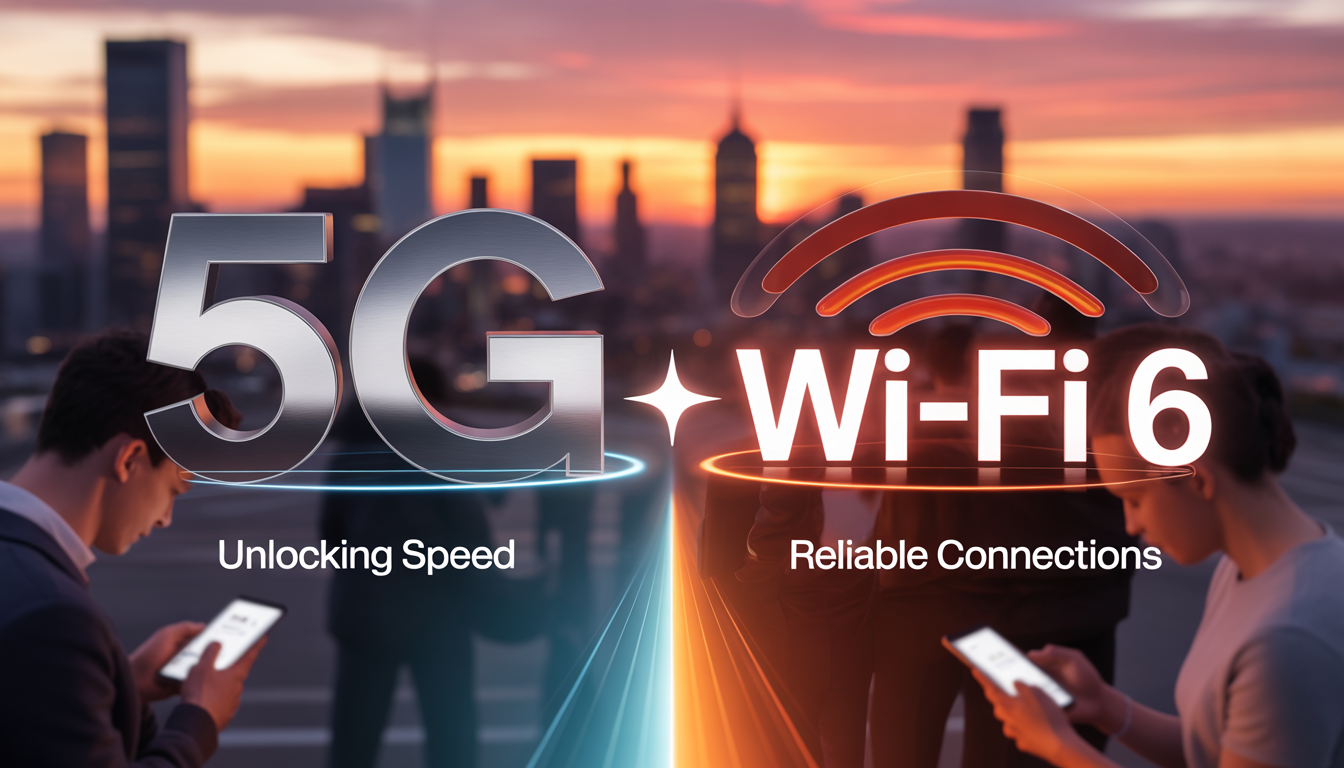
As India accelerates toward digital transformation, choosing the right connectivity technology is crucial. 5G and Wi-Fi 6 promise faster speeds, lower latency, and better reliability—but which one fits your needs? This guide breaks down the differences in a beginner-friendly way, helping you make informed tech decisions.
What is 5G and Wi-Fi 6?
5G: The fifth-generation cellular network, designed to deliver ultra-fast internet, low latency, and massive device connectivity over wide areas.
Wi-Fi 6: Also called 802.11ax, it is the latest Wi-Fi standard, optimized for faster speeds, better performance in crowded spaces, and improved battery life for connected devices.
Snippet-ready sentence:
5G is the next-gen mobile network for wide-area high-speed connectivity, while Wi-Fi 6 is a high-performance local wireless standard ideal for homes, offices, and public hotspots.
Why It Matters / Who Benefits
- Tech buyers & consumers: Faster downloads, smoother streaming, and gaming.
- Businesses & enterprises: Reliable connectivity for smart offices, IoT devices, and cloud-based apps.
- Developers: Optimized network performance for app development and testing.
- Public services & cities: Smart city infrastructure, remote monitoring, and connected transport.
How It Works / Key Features
5G Key Features
- Frequency bands: Operates on low, mid, and high (mmWave) frequencies.
- Speed & latency: 100 Mbps–10 Gbps; latency as low as 1ms.
- Coverage: Wide-area, suitable for mobile users and city-wide networks.
- Connection density: Supports millions of IoT devices per square km.
Wi-Fi 6 Key Features
- Speed & capacity: Up to 9.6 Gbps; handles multiple devices efficiently.
- OFDMA & MU-MIMO: Reduces congestion in dense networks.
- Target Wake Time (TWT): Saves battery for mobile and IoT devices.
- Coverage: Limited to home, office, or hotspot range.
Practical Use Cases & Examples
- 5G:
- Mobile gaming without lag in metro cities.
- Real-time AR/VR applications in education or retail.
- Smart traffic management in connected cities.
- Wi-Fi 6:
- High-speed streaming in crowded homes or offices.
- Conference rooms with dozens of simultaneous devices.
- IoT home automation systems.
Comparison / Alternatives
| Feature | 5G | Wi-Fi 6 |
|---|---|---|
| Coverage | Wide-area, city/country level | Local, home/office/hotspot |
| Speed | 100 Mbps–10 Gbps | Up to 9.6 Gbps |
| Latency | ~1–10 ms | ~5–10 ms |
| Device Density | Millions per km² | Hundreds per network |
| Mobility | High (for moving devices) | Low (mostly stationary) |
| Cost | Data plans required | Usually one-time router cost |
| Ideal Use Case | Mobile, outdoor, IoT | Indoor, offices, homes |
Benefits & Limitations
5G Pros
- Ultra-fast mobile internet
- Wide coverage, supports mobility
- Ideal for IoT and smart cities
5G Cons
- Expensive data plans
- High-frequency mmWave limited by obstacles
- Infrastructure rollout still ongoing in India
Wi-Fi 6 Pros
- High-speed local connectivity
- Handles crowded networks efficiently
- Cost-effective for homes and offices
Wi-Fi 6 Cons
- Limited range; needs multiple access points for large areas
- Depends on router and device compatibility
Implementation / Buying / Adoption Checklist
- Assess your needs: Mobile outdoor use (5G) vs indoor office/home (Wi-Fi 6).
- Check device compatibility: Phones, routers, laptops, IoT devices.
- Consider budget: Data plans for 5G vs upfront router cost for Wi-Fi 6.
- Plan coverage: Use Wi-Fi extenders for large homes; verify 5G coverage in your city.
- Security setup: Enable WPA3 for Wi-Fi 6; follow carrier recommendations for 5G.
Frequently Asked Questions(FAQs)
Q1: Can I use 5G and Wi-Fi 6 together?
Yes. Devices often switch between 5G and Wi-Fi 6 automatically for optimal speed and cost savings.
Q2: Which is faster, 5G or Wi-Fi 6?
Wi-Fi 6 can reach slightly higher speeds indoors, but 5G provides better mobility and coverage outdoors.
Q3: Is Wi-Fi 6 worth upgrading to in 2026?
Absolutely, especially for crowded offices or homes with multiple smart devices; it ensures stable, high-speed connections.
Q4: Do I need a new phone for 5G in India?
Yes. Only 5G-compatible phones can access 5G networks.
Q5: Which is better for gaming: 5G or Wi-Fi 6?
Wi-Fi 6 is ideal for indoor gaming due to lower interference, while 5G works for mobile and outdoor gaming.
Conclusion
Both 5G and Wi-Fi 6 are transformative connectivity technologies. Choose 5G for mobility and city-wide coverage, and Wi-Fi 6 for high-speed, stable indoor networks. As India’s digital landscape evolves, a hybrid approach leveraging both technologies will likely become standard.
Read more: AI in Everyday Life: 5 Useful Applications You Should Know
LSI / Semantic Keywords
- 5G network India
- Wi-Fi 6 router
- Mobile internet speed
- Low-latency connectivity
- Smart home technology
- IoT device networking
- Wireless technology comparison
- Next-gen connectivity
